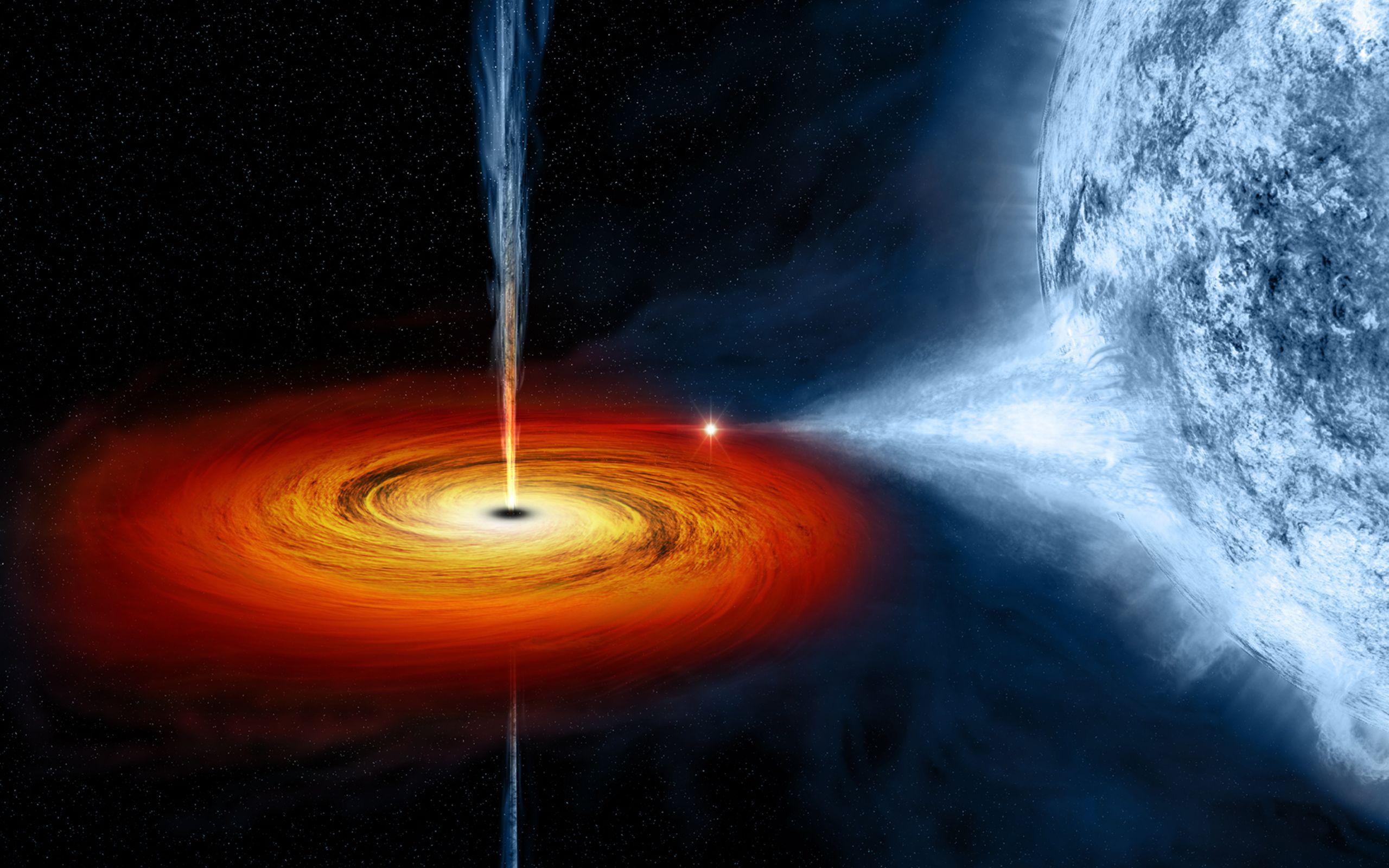
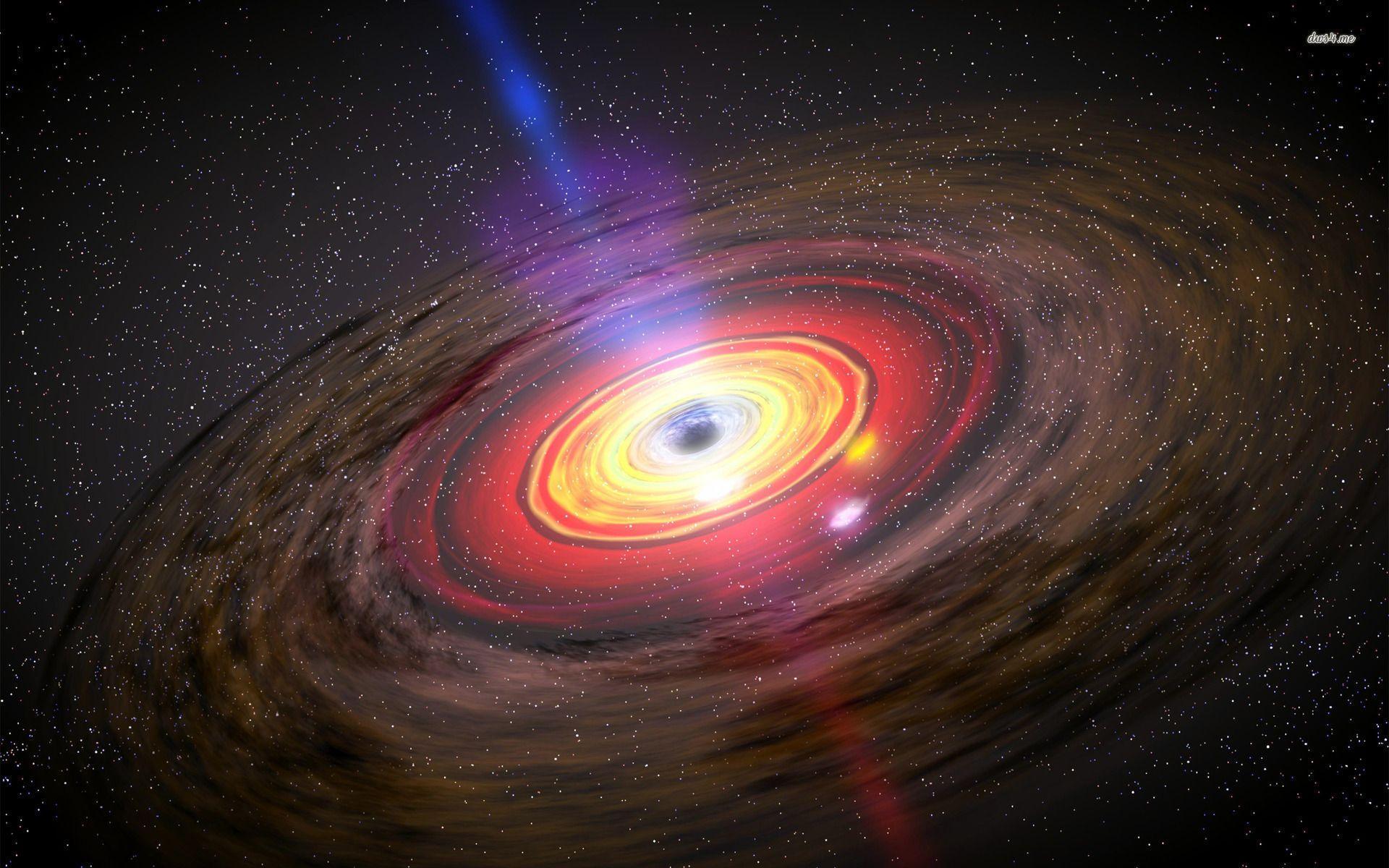
The black hole named Cygnus X-1 formed when a large star caved in. This black hole pulls matter from the blue star beside it. Credits: NASA/CXC/M.Weiss

Caption text

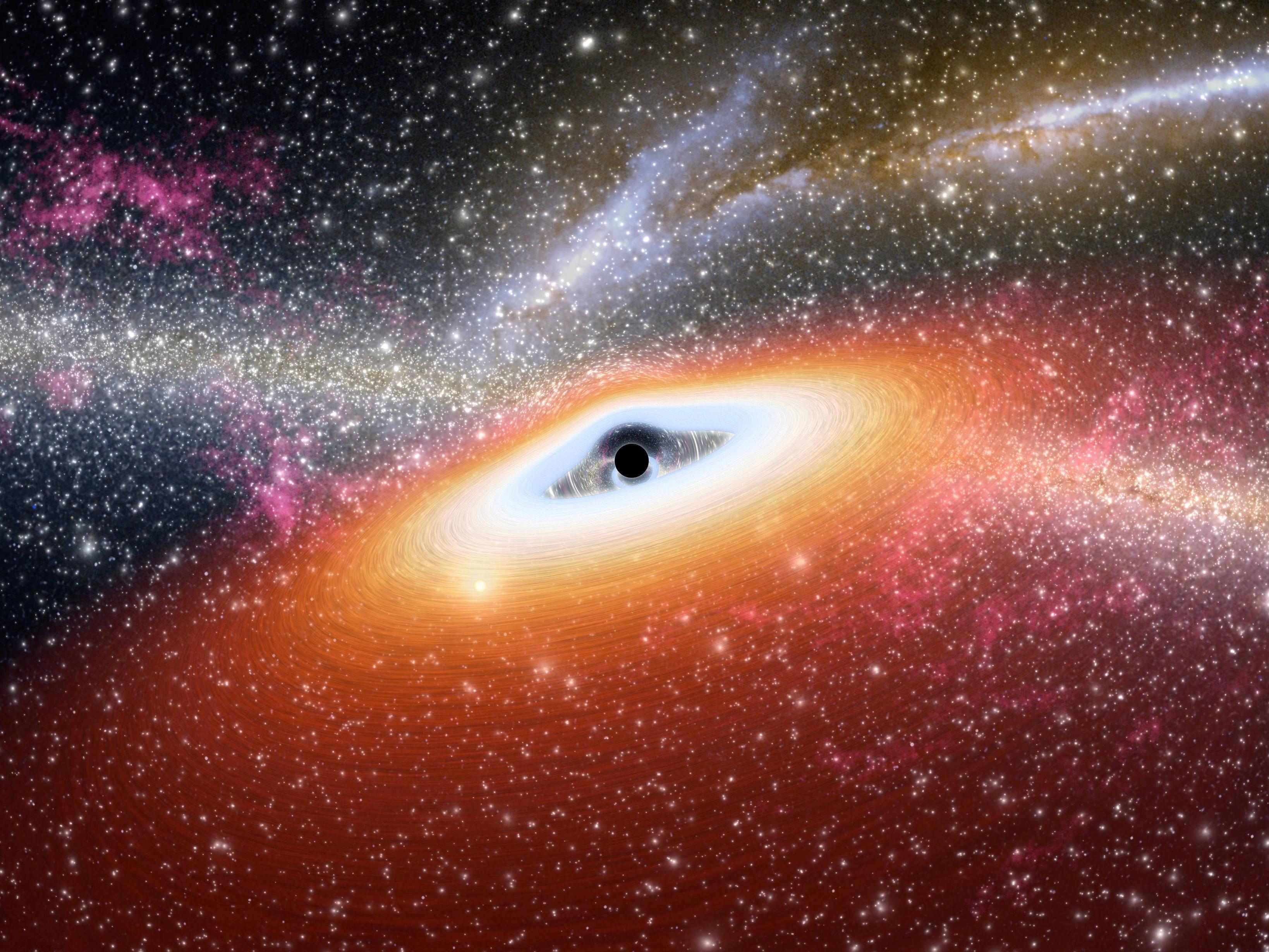
Illustration of a young black hole, such as the two distant dust-free quasars spotted recently by the Spitzer Space Telescope.(Image credit: NASA/JPL-Caltech)

Caption text

NASA Visualization Shows a Black Hole’s Warped World https://www.nasa.gov/feature/goddard/2019/nasa-visualization-shows-a-black-hole-s-warped-world)

Showing posts with label blackholes. Show all posts

Thursday, May 13, 2021

Collision: Destruction or Creation


   We still know how giant and strong these black holes are. This was all for about a single black hole, but now imagine what would happen if a black hole collided with another black hole of about the same mass. What will be the result of this destruction? Will it be a very huge big bang or the creation of a new beast? So, let’s find out what will happen.

Binary black holes.


     A binary black hole system is a pair of black holes revolving around a particular point that is its epicenter. So, is the collision of all the black holes the same? The answer is no, as when different sizes of black holes collide with each other, the resultant energy released is different. That is, the collision of two stellar black holes will result in a different amount of energy being released than the collision of two supermassive black holes. So, there are different types of collisions. One type of collision is the collision of two stellar black holes formed by the revolution of the remains of two heavily dense stars revolving around a particular point. Then there is the collision of two galaxies that results in the collision of two super massive black holes. So, all these black holes before colliding revolve around each other, and this system is coined as the binary black hole system.

 Process of collision.


    Imagine two black holes of nearly 80 solar masses each. That is the mass of 80 suns densely packed together into an area that is the size of Japan. Then what would happen is the formation of a black hole. Now, imagine two black holes, the second one similar to the first one we discussed earlier, approaching each other. What will happen? Earlier, when it was not observed, it was very difficult to locate a black hole precisely where it was and how far it was from us, because the black hole does not give any signs of its existence due to its terrible gravitational force. But when two black holes collide, an immense amount of energy in the form of gravitational waves is released in the space and time whose energy has been calculated by the use of general relativity. It is said that the collision of two black holes results in the strongest and largest production of gravitational waves. These are the only quantities that remain the same in all dimensions, so it is easy to detect them. As the gravitational waves are released, the orbit of a black hole decays, and the period of the orbit also decreases. This whole phenomenon is known as an inspiral. Once it happens, the back holes start to merge into each other, and finally a single black hole is formed. In this process, as two black holes combine, the total mass of the black hole is not the same as the addition of the masses of two black holes, as at the time of collision, a huge amount of energy is released in the form of gravitational waves. So some amount of mass is converted into energy in the form of gravitational waves and released.

So, what ones happened is….

    On the 14th of September 2015, approximately 1.4 billion light-years from Earth, two black holes spiraled around each other and, after some time, collided, creating waves in the fabric of space-time. These waves, known as gravitational waves, arrived at Earth and were observed and announced by Virgo and LIGO in February 2016. The readings given by LIGO were approximately and more accurately correct and were accurate to the general relativity prediction of two massive bodies spiraling inwards towards each other, having asses approximately equal to 36 and 29 solar masses, which finally emerged into a single black hole. The signal that was detected was named GW150914, which says, Gravitational waves noticed on September 14, 2015. It was the first time an observation of the merging or collision of black holes was observed and put forward with proof. This gave a clear response that the collision of stellar black holes still occurs in this age and era. Earlier, gravitational waves had only been inferred indirectly, via their effect on the timing of pulsars in binary star systems. The news of the first direct observation was spread around the world as a remarkable achievement for many reasons. Many efforts have been made in the last fifty-five years to show the existence of such waves, and the waves are so small that Albert Einstein himself never thought that they could ever be detected. But, this gave the boost to the scientists and researchers that they needed for a long time to discover many more things about them, and the day is not so far when we could actually go near this beast.

Monday, April 12, 2021

Entropy of Black hole


Introducing thermodynamics to Black holes.

Entropy is the term which when we read about it leads us to the path towards thermodynamics. In the early 1800s, researchers and scientists started studying heat, temperature, and the behaviour of gases, which later evolved into thermodynamics. According to thermodynamics and the famous three laws of thermodynamics, it says that:

  • The zeroth law states that if two bodies are each in thermal equilibrium with a third body, then the first two bodies are also in thermal equilibrium with each other.
  • The first law states that the total energy of an isolated system always remains constant. It can only transform from one state to another but never be destroyed.
  • The second law states that the change in the entropy of the entire universe can never be negative.
  • The third law states that the entropy of a system at absolute zero is a well-defined constant.

So, considering all this above, many controversies and paradoxes arise when we try to apply them to black holes. As black holes have mass, rotation, and temperature, it is obvious for them to have entropy, so as the second law states that (the total energy of an isolated system always remains constant, it can only transform from one state to another but never be destroyed). The energy of a black hole should always remain constant, but if you could throw an object (with a considerable amount of entropy) into a black hole, the entropy would simply go away. It would vanish nowhere. In other words, the entropy of the system would get smaller and smaller, which would violate the second law of thermodynamics. Considering another situation is that the classical black hole has a temperature of absolute zero. This means you could take a bucket full of hot water and throw it into a black hole, which would essentially be cooling an object to absolute zero. It is a violation of the third law of thermodynamics.


Bekenstein-Hawking entropy :


 Bekenstein-Hawking entropy, also known as black hole entropy, is the amount of entropy that a black hole must have in order to obey thermodynamic laws as interpreted by observers outside the black hole. A black hole can be formed in many ways . After it settles down, space and time outside are described by only M and J. The radiation it emits is essentially thermal. It can’t depend on the information inside without violating causality or locality. 

There are several ways to justify the entropy of a black hole.

  • Considering the loss of signal with a body outside the black hole, when a body enters into a black hole, it is the same as the loss of information, and in ordinary physics, entropy is the measure of the loss of information. Hence, entropy can be defined for a black hole.
  • A black hole is usually formed from the collapse of matter under its own gravity or radiation. Both the terms which relate to the formation of a black hole, i.e., matter and radiation, are associated with entropy. However, the black hole’s matter inside is unknown to the observer outside the black hole. Thus, a thermodynamic layout of the collapse from that observer's point of view cannot be based on the entropy of that matter or radiation (the key roles in the formation of a black hole) because these are unobservable. Associating entropy with the black hole provides a handle on thermodynamics.


Formulation for a concrete formula for entropy…

There is a need for a concrete formulation to describe the entropy of a black hole, but from the above discussion it is clear that only the observable parameters can be considered for the formulation of black holes. So the major observable parameters were mass, angular momentum, and electric charge. So, taking the area theorem into consideration, all these parameters come into the same combination as that which represents the surface area of a black hole. The area theorem states that the surface area of a black hole can’t decrease; it can only increase in black hole transformation. So, the final formulation provided as a solution to all these is


Where,
             A represents the surface area of black hole.
             G Newton's gravity constant.
             h the Planck-Dirac constant (h/(2Ï€)).
             c speed of light.

   For, Schwarzschild or spherically symmetric black hole the horizon's radius is 

So,                      
                                     A=16Ï€(GM/c2)2

Hence, the considerable efforts to make all the parameters fit to make a defined formulation to find the entropy of black was possible, but still, much more research is going on to find more reasonable formulations in the present and future.

Thursday, March 18, 2021

Accretion Disc.


Discovering the nature around the black hole.

    One of the most important parts of a black hole by which we can actually locate or see a black hole is the accretion disc. So, what is this disc? The answer to this question is very simple. It is a disc formed by diffused matter around a heavy, dense, or massive central body, such as a black hole. So, now it is clear that the disc contains only diffused material, but then why does it glow so much? The reason is that, due to friction, the diffused material is pulled inward towards the central body, and under this immense pressure and friction, it gets compressed and its temperature increases to a very high level, a level so high that the diffused material appears to glow and it emits electromagnetic radiation, and the frequency of the waves depends on the mass of the central body.

What physics says about it,


    The physical definition of a black hole is when matter accreted has enough rotational and angular momentum to prevent it from falling inward into its own accretor. As black holes take everything inside them once it is trapped, there is no possibility That light can also escape its grasp, so like its name, it is pitch black, so it is very difficult to detect. But once the black hole is fed by its vicinity, it becomes the brightest in the cosmos.  There are many ways for black holes to light up their cosmic surroundings. Some of the black holes require very special circumstances, but one that is universal is that whenever matter falls into a black hole, there is the production of thermal radiation. Matter falling towards a central object under the influence of gravity gets accelerated to higher and higher speeds and travels faster and faster, gaining more and more kinetic energy. But once a particle of falling matter plunges into an accretion disc – and possibly earlier – the particle’s motion is disturbed. So, due to these frequent collisions, there is no specified orbit of rotation.

 The entire motion is chaotic; none of the particles follow a definite path. However, this is typical of an accretion disc. As the particles fall inwards, motion becomes chaotic, and matter in the accretion disc is heated to very high temperatures, the temperature of which is far beyond our imagination. The maximum temperature in an accretion disc around a super massive black hole, which is about a hundred times the mass of our sun, will be around one million kelvin, and for the disc around a stellar black hole, it can be up to a factor of a hundred higher than the super massive one. By comparison, the temperature in the core of our sun amounts to about 15 million Kelvin, so by this we can get an idea of how high the temperature of the accretion disc can be. In physics, wherever there is a reference to heat, there is always a word about thermal electromagnetic radiation. Everyone emits thermal radiation in some way because, according to the law, the heat in a body cannot remain constant if it is to be released or exchanged with the environment over its entire lifetime. Only a body with an absolute zero temperature would not, but such bodies do not exist in this world. As the temperature of the body increases, so does the energy emitted in the form of radiation. The temperature of an accretion disc around a black hole is high enough for the disc matter to emit large amounts of highly energetic X-rays.


Concluding it with the help of quasars

    These accretion discs are also known as quasars. Quasars are the oldest known bodies in the universe and (with the exception of gamma ray bursts) the most distant objects we can see until now, as well as the brightest and most massive, outshining trillions of stars. So, all that we see in the accretion discs are small quasars which collide with each other, releasing an enormous amount of heat and energy. Therefore, the black holes would have been hard to detect and our research into them would not have been to its level where it is now if there had been no accretion disc around the black hole. They are the source of light or vision for us to see it.

Wednesday, February 17, 2021

Singularity

Concept Of Singularity:

     So, when we read about black holes, the most common question is, "What is a gravitational singularity?" Then the answer to this most frequently asked question is very simple. The term singularity means the single center point of black holes, which is one-dimensional and contains a huge amount of mass in that infinitely small point, where the density and gravitation become infinite. It is a region where the spacetime curvature becomes infinite. It is predicted that any star reaching beyond its point of limit or a certain point in its mass would exert a gravitational force so strong that it would collapse under its own gravity. For a non-revolving black hole, this region takes the shape of a single point, and for a revolving black hole, it is smudged out to form a ring singularity that lies in the plane of rotation. In both aspects, the singular region has zero volume. It can also be shown that the singular area contains all the mass of the black hole solution. The singular area can thus be thought of as having infinite density.

Is there only one type of singularity ?

  Singularities are of many types, arising from different characteristics of the theories from which they emerge, such as according to different shapes. As a result, the singularity can be classified as conical or curved. So let’s see both one by one.

   Conical Singularity

     A conical singularity occurs when there is a point in space where the limit of every general invariant quantity is finite. Due to this, space-time is not smooth at the point of limit. So, it looks like a world where all space-time surrounds the conical tip that is the point of singularity. The Schwarzschild Black is a very good example of this type. An example of such a conical singularity is a cosmic string, a type of hypothetical one-dimensional point that is believed to have formed during the early Universe.

Curvature Singularity

     What happens is that while solving the equations of general relativity or of gravitational equations, we come up with a function that defines the distance between each pair of elements of a set, which is also called metric points tending to infinity. So sometimes it happens that these points are completely smooth, which is found by the continuous derivative of the function.

In order to test whether there is a singularity at a certain point, one must check whether at this point the general covariance quantity becomes finite. Such quantities are the same in every coordinate system, so these infinities will not "go away" with a change of coordinates. A Curvature Singularity is the best example of a black hole. At the centre of a black hole, space-time becomes a one-dimensional point, which contains a huge mass densely packed into a point. As a result, gravity becomes infinite, space-time curves infinitely, and the laws of physics as we know them cease to function.

Another type of singularity is a naked singularity, which is one that is not hidden behind an event horizon. In this case, what actually transpires within a black hole would be visible. Such a singularity would theoretically be what existed prior to the concept very famously known as the Big Bang. The major, or essential word here, is theoretical, as it remains a mystery what these objects would look like. Singularities play a major part in the existence of singularities. The singularity of space-time can also be defined as an indefinite or incomplete path which does not have any end or beyond which we don’t know what exists.

But does it really exist ?

    In the real universe, no black hole has singularities. In general, singularities are the non-physical mathematical results of some imperfect physical theory. When scientists and researchers talk about black hole singularities, they are talking about the errors that appear in the current theories and not about objects that actually exist. A Singularity can be seen in this light, so what exactly is it? It is that point where the mass is infinite at an infinitely small point, but in our real world, the term infinite does not exist. Whenever an infinity term comes up in a theory, it is simply a reason that your theory is too simple to handle extreme cases. So let us consider a case. Assume that we are continuously supplying heat to a particular glass plate. According to theories, what should happen is that the glass plate must heat up to infinity, but in reality, the case is different. The glass plate will melt after reaching a particular temperature, which is its melting point. So, this might show that the singularity term is just on the pages.


Wednesday, December 16, 2020

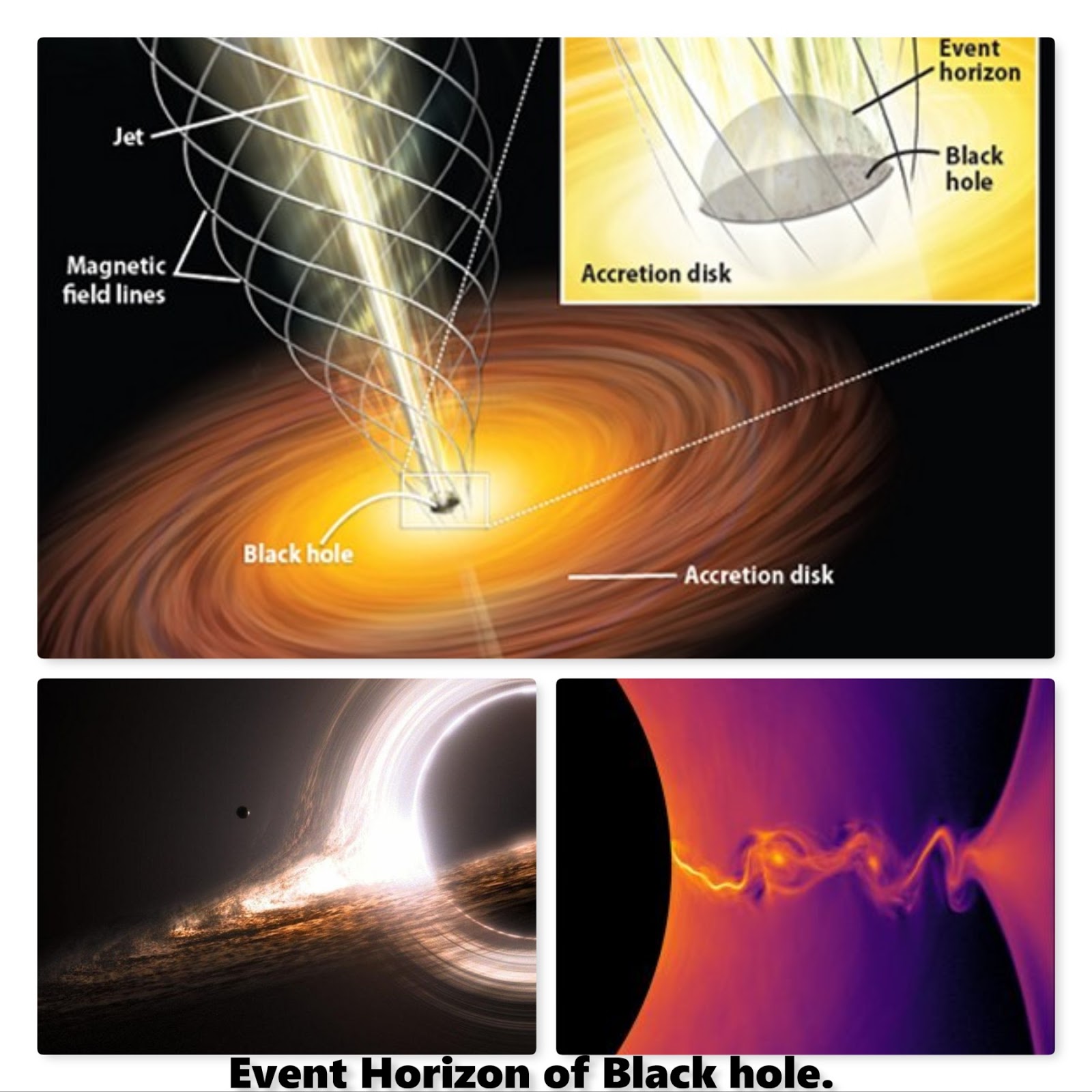
The Event Horizon.

So, what is the event horizon…?

       Black holes are still one of the mysterious things that exist and attract everything inside them that crosses the boundary. This boundary is known as the "event horizon. An event horizon, a term associated with a black hole, is a point from which the gravitational attraction is so strong that even light can't escape through it. An object which crosses this boundary or approaches towards it is observed to be moving slower and slower and never appears to pass through the event horizon. The object appears stretched and, due to redshift, appears redder as it moves towards the black hole. This point is also called a point of no return, as from here if an object wants to return, its escape velocity needs to be greater than the speed of light. That is, it needs to travel against the pull of a black hole in the opposite direction at a speed greater than the speed of light.

What does the past say...?

  So, in 1784, the Newtonian theory of gravitation and the particle theory of light were dominant, and they proposed that if the required escape speed was greater than the speed of light, light originating inside or from such a distance of super massive objects could escape temporarily but would return. But, at the same time, John Michell proposed that near super massive objects, the pull of gravitation would increase to such an extent that not even light could escape. After a long time, in 1958, David Finkelstein, using General Relativity, proposed that the boundary, i.e., the event horizon, is the final boundary of a black hole, beyond which nothing can escape the attraction of black holes.


The future and past for the event horizon….

Black holes are generally final in nature; that is, we need to know all the future space-time of a black hole to identify its correct and current location, which is practically impossible. Generally, the model suggested earlier for black holes has

It does not tell us that black holes rotate and have a fixed point singularity, but now the present situation is different and proposes that the black hole has a spin. Because of this, the singularity does not remain as a point, but now it is a collection of compact discs. Because of this  the event horizons of rotating black holes appear uneven and also squashed at the poles and bulging at their equators. As presented by today's situation, a rotating black hole is surrounded by a region of space-time in which it is impossible to stand erect in the same position, called the ergo sphere. This is due to a process known as frame-dragging, which says that any rotating mass tends to drag slightly along the space-time surrounding it. But still, space-time in it is technically pulled a bit faster than the speed of light.


The flow of time in the event horizon.

Due to extreme gravitational forces, it has some effect on time. Time inside the boundary of the event horizon slows down as gravitation is inversely proportional to time. This phenomenon is known as gravitational time dilation, relative to observers outside the field. So, for a person inside the event horizon and a person outside it, time moves differently. The person inside the event horizon is never seen to be moving by the person outside because the time difference is huge. So, the denser the black hole is, the greater the pull of gravitational attraction and the slower time moves. As shown in the film Interstellar, the main character discovers different planets around a black hole, and the time spent on each planet differs significantly from the time spent on Earth.

The final conclusion to sum up.

  Some virtual particles exist at the boundary of the event horizon. These particles are continuously divided. That means half of the particles are drawn inside the black hole and half of them move out of the black hole and become real particles. The particles that move inside the black hole have negative energy, which combines with the positive energy of the black hole, resulting in the loss of energy. This process is slow at the start, but as the size of the black hole becomes smaller, the process catches up in speed, but still, with respect to time, this process is very slow.


  Schwarzschild's radius is the radius to which an object needs to be squeezed, keeping its mass constant so that it collapses under its own gravitational field. As an example, to convert the earth into a black hole, we need to squeeze it to the size of a marble with an inch diameter. The radius which it defines is the radius of the event horizon from the singularity to the boundary. The objects far away from the event horizon move according to their own space-time, but as they approach the event horizon, the black hole sucks up all the space-time and the motion of the object is inevitable the same as time. It can now move only in one direction, and that is inside the black hole. But the observer never sees it cross the event horizon because as we get closer to the black hole, the gravitational force increases and time slows down, so it takes an infinite amount of time for the object to cross the event horizon.

Tuesday, November 10, 2020

Types of Black Holes


As observed by scientists and astronomers, all black holes are not exactly the same. Black holes are completely classified by only three conditions: massrotation, and charge.

Classification black holes according to rotation and charge :


  1. Schwarzschild Black Holes

Non-rotating black holes are called Schwarzschild black holes. These black holes don't have rotating cores and have two main properties: a singularity and an event horizon. These holes don't have any electrical charge. It is characterized solely by its mass.

  1. Kerr's Black Holes:

Rotating black holes are termed "Kerr black holes. These black holes rotate because the object that collided into the black hole was originally rotating. 

They have four main properties: 

  • A Singularity 
  • An Event horizon
  • The Ergosphere
  • The Static limit. 

There is no presence of electrical charge in these holes.

  1. Black Holes with Charges:

There are two types: A charged and non-rotating black hole is called a Reissner-Nordstrom Black Hole.

When a charged, rotating black hole is known as a Kerr-Newman Black Hole.

  • According to the classification by mass, there are 3 types:
  1. Stellar mass black holes.
  2. Intermediate Mass Black Holes
  3. Supermassive Black Holes.

Stellar Black holes - small but strong


   These types of black holes are comparatively smaller in size than the other two. Their sizes range from a few 5-6 solar masses to a few hundred times the solar mass. So, when a star with a core twice to three times the size of our sun burns completely to iron, its energy production ceases and it collapses into a stellar black hole. These black holes are also called Kerr black holes as the rotation of the original massive star is conserved during the time of collapse and it contains very little electric charge. These black holes are mostly uncharged and rotate along their own central axis.

Finding a black hole is very hard since the radiation emitted cannot escape the gravitational pull of it. But the way in which the scientists found them is through an X-ray binary system. When the gases from the star nearby to it or acting as a companion to it are sucked into it, x rays are produced by these gases, which heat up to millions of degrees. So far, nearly 20 x-ray binary systems with a stellar black hole have been discovered so far.The nearest stellar black hole is V616 Monocerotis, which is nearly 3000 light-years away from us and nearly 10–14 times as massive as our sun.


Intermediate black holes - stuck in the middle

    The size of these black holes varies from 100 solar masses to nearly a hundred thousand times the mass of the sun. These black holes are certainly larger than stellar black holes, but not as large as supermassive black holes.

The true surety of finding these black holes is still a mystery, but many intermediate-mass black holes are found in our galaxy and nearby due to the accretion disc and gas cloud spectral. The strongest result which shows that these black holes exist is the low luminous active galactic nuclei that are the centre of the galaxy and have a comparatively higher luminosity, which is certainly not exhibited by a star. The origin of these types of black holes is determined by these three ways.

They were formed at the time of the Big Bang, so they are primordial black holes. Secondly, by the merging of stellar black holes and other smaller objects together. The third way is through the collision of massive stars in a dense stellar cluster.


Supermassive black holes - Giant-Sized 

     These are the largest types of black holes, being the size of a few thousand to millions of times the size of our sun. These black holes are very large compared to the other two types of black holes. Because of being so large, the density of these black holes is less than the stellar and intermediate-mass types of black holes. As we know, the Schwarzschild’s radius is proportional to mass, so for spherical objects, the density of objects is inversely proportional to the square of mass. So, the larger the black hole, the lower the average density. The pull of the supermassive black hole is also weaker than the other two black holes inside the event horizon.

     The origin of these types of black holes is still an open mystery, but still, as long as there is a black hole at the centre of every galaxy, it continuously grows by feeding the matter around it or by merging with other black holes. The active galactic centre of galaxies is where most of the supermassive black holes exist that continuously engulf the matter and are the source of the extreme luminosity at the center.

The supermassive black hole at the centre of our Milky Way galaxy is Sagittarius A*. Its diameter is said to be 44 million km and it is about 25,640 light-years from Earth.

Still, there are many more things to know about black holes, which we will discover slowly one by one.


Thursday, October 15, 2020

The super massive Sagittarius A*.

What supermassive black holes really are ?

  Supermassive black holes exist at the centre of every spinning galaxy. They are very huge and continuously feed themselves off the surrounding matter. Astronomers are monitoring the colossal object called "Sagittarius A*," the supermassive black hole that exists at the centre of the Milky Way galaxy. The Sagittarius A* is a supermassive black hole at the rotational centre of the Milky Way galaxy, also known as the galactic center. The galactic centre is 26,490  100 light-years away from Earth in the direction of the constellations Sagittarius, Ophiuchus, and Scorpius, where the Milky Way appears brightest. It coincides with the compact radio source Sagittarius A*. The presence of numerous stars, most notably the S2 star, has provided evidence of the presence of the Milky Way's central supermassive black hole, and has led some scientists to conclude that Sagittarius A* is beyond any reasonable doubt the site of that black hole.

So, how big our galaxy is and where the black hole is…?    


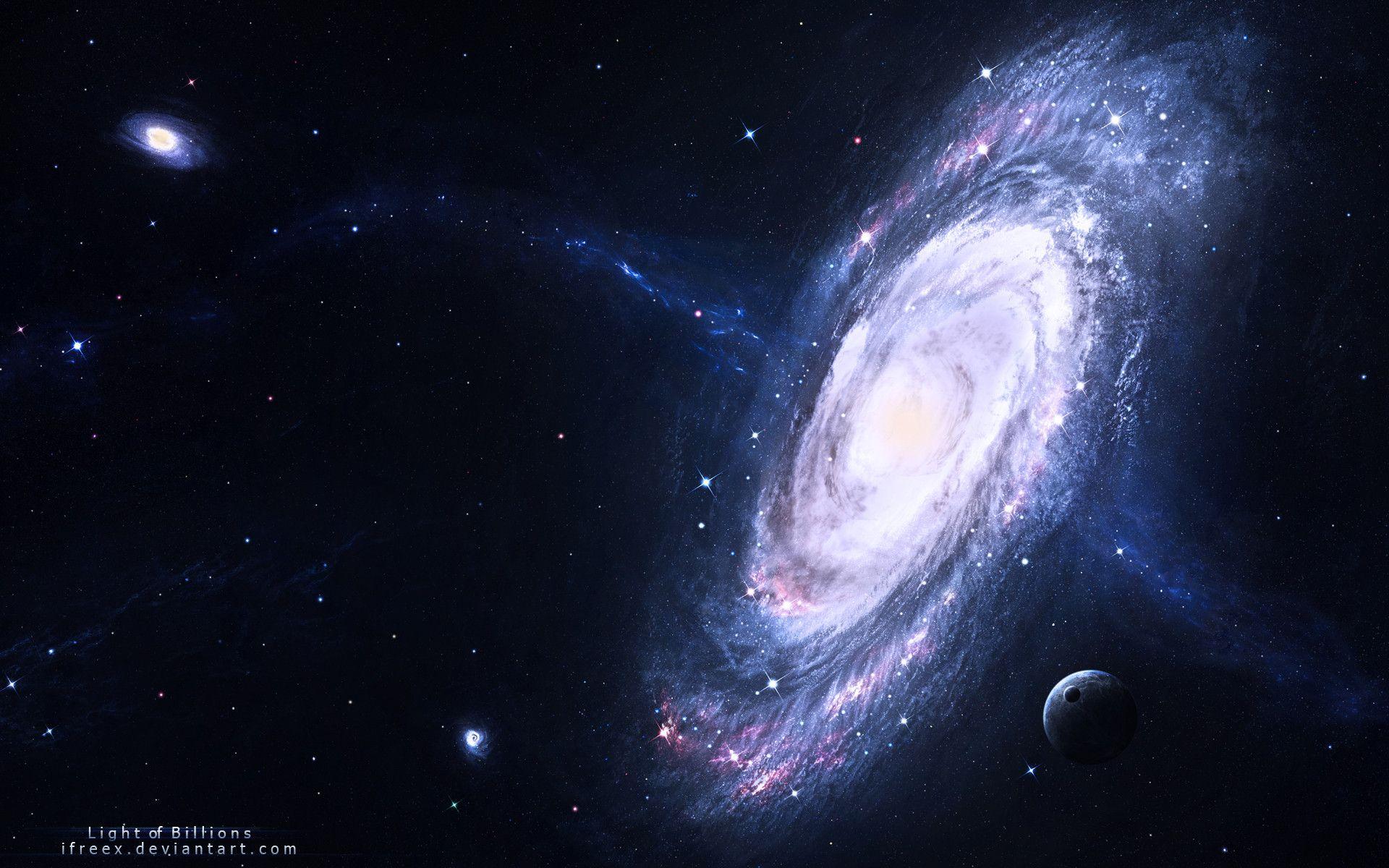
     Our galaxy, the Milky Way galaxy, is one of the galaxies in the cluster of many galaxies. It is not very huge and bright if we compare it with the largest galaxy known to us, which is IC 11O1, which has a diameter of 6 million light-years and is the single largest galaxy that has ever been found in the observable universe, as that of the Milky Way is just about 100,000 light-years. By the calculations, Sagittarius A* is situated at the centre of it, which is nearly 26000 light-years away from us, and by the calculations, it is roughly 4.1 million times more massive than the sun.


 How we can see the Sagittarius A* ?

  Astronomers have been unable to observe Sagittarius A* in the optical spectrum because of the effect of 25 magnitudes (i.e., one unit less brightness of an object in a defined passband) of extinction by dust and gas between the source and Earth, and also because the black hole itself cannot be seen because it acts as a one-way path even for light. But it is possible to detect radiation blazing from gas and dust just outside the "event horizon" as they are accelerated, which is about 1/10 the speed of light. The brightness of the black hole at the heart of our galaxy has increased by 75 percent—the brightest it has been since scientists first started studying it more than 20 years ago, as it is continuously feeding the matter surrounding it. It is said that more gas is falling into the black hole, and that leads to higher amounts of accretion, which leads to it being brighter. Sagittarius A* is on the verge of being imaged by the Event Horizon Telescope. When it’s accomplished, the picture of the Milky Way’s supermassive black hole, Sagittarius A*, will be the greatest success for all of us.

Thursday, September 17, 2020

The journey continues towards the black hole.


So, what happens around it…?

         The mysterious objects that lie far away beyond our reach are those mysterious objects that give very little information about them, but the search for all new information goes on every day and every time we get some new information. We know and can tell what happens outside the black hole near it, but we don't have any chance to know what's inside it. As we approach the event horizon, the pull of gravity towards its center, i.e. the singularity, becomes so strong that we must travel faster than the speed of light to escape, which is currently impossible for us. Also, if we try to send a probe inside it, then it will be impossible for it to transmit signals back to us, as the pull of the black hole is so strong that even light can't escape its grasp.


Thermodynamics opposes it.

       So, according to it, whatever goes inside never comes back. This is what deviates from the second law of thermodynamics. Imagine if you threw a bucket full of hot water into a black hole. Then, according to the second law of thermodynamics, entropy is always an increasing function in a closed system, and the universe is a closed system. So, the hot water thrown inside a black hole will lose its entropy eventually as it falls into the black hole.


So, how are they so bright ?


       The black part that we see is actually the event horizon. Then what's the big deal about? A black hole is the singularity that lies at the centre, deep inside, where the whole mass is dense. When we see a picture of a spiral galaxy, we see a super source of light at the centre of it. That is a black hole. But from where the light comes from, as we know, even light can't escape the pull of a black hole. So, the light that we see comes from the magnetic field near a spinning black hole that propels electrons outward along the rotational axis and produces radio waves.

Quasars are quasi-stellar objects that are very highly energetic objects that surround an actively feeding, super massive black hole. That is, the black hole at the centre of each galaxy continuously feeds intermittently, and due to these feedings, highly dense gas moves at a very high speed. It forms an extremely bright and hot disc spiralling around the black hole, and if this black hole is continuously swallowing a large amount of material, this feeding results in gigantic jets of gas that are quasars. These quasars are the fuel for the black hole. But still, black holes continuously radiate their mass away, like a pot filled with water boiling on the stove and the water turning into steam and becoming smaller and smaller. This is known as Hawkins radiation. But this process is very, very slow.


Wednesday, July 15, 2020

Black Hole: Definition & History

What Are Black Holes?  

Black holes are the super-massive, dense regions of space-time where gravitational acceleration is so strong that nothing can pass through them, not even light can escape through them.


History Of Black Holes.

     Black holes were first considered in the 18th century by John Michell and Pierre-Simon Laplace. Then, in 1916, Karl Schwarzschild found the first solution to the theory of general relativity that would describe black holes. He also discovered the concept of Schwarzschild radius, which describes how large a black hole can be based on its mass or density. But the concept that nothing can escape the pull of a black hole, which means that the gravitational black hole is enormous, was first proposed by David Finkelstein in 1958. But, more information about black holes was jotted down when the discovery of neutron stars took place by Jocelyn Bell Burnell in 1967, and from that day till now, every day we get to know more about black holes.

Pathway To Discovery:


    • 1687- Sir Isaac Newton described the gravity in his publication, "Principia"


    • 1783- John Michell suspected that there might be a massive object enough to escape velocity greater than the speed of light.


    •  1796- Simon Pierre LaPlace assumed the existence of black holes." It is, therefore, possible that the largest luminous bodies in the universe may, through this cause, be invisible"- Le Systeme du monde ( The System of the World )


    • 1915- Albert Einstein issued the Theory Of General Relativity, which surmised spacetime curvature.


    • 1916- Karl Schwarzchild used the theory of relativity to explain the black hole.  The explained gravitational radius of black holes, later named as Schwarzchild radius.


    • 1926- Sir Arthur Eddington along with Einstein opposed black hole theory.


    • 1935- Subrahmanyan Chandrashekhar discovered the theory of white dwarfs that led to an understanding of mass limits that decide whether a star will die as a dwarf, neutron star or black hole.


    • 1964- John Wheeler coined the term, "black hole".


    • 1964- Jocelyn Bell Burnell found neutron stars that, at the time, were the densest matter found through inspections.


    • 1970- Sir Stephen Hawking described the modern theory of black holes, which explains the final fate of black holes.


    • 1970- Cygnus X-1, the first good black hole candidate that astronauts found. It releases x-rays and has a partner smaller than Earth although with a mass greater than that of a neutron star.


    • 1994- Hubble Space Telescope gave the best evidence to date pf supermassive black holes that lie low in the centre of some galaxies. The Space Telescope Imaging Spectrograph (STIS) disclosed largely orbiting velocities around the nucleus of these galaxies, proposing a huge mass inside a very small region.


What the laws say?

The laws of general relativity differ from the classical mechanical laws, and according to general relativity theory, a mass sufficiently compressed or compact can deform space-time to form a black hole. A black hole consists of a region around it from which no object can escape. As the pull of gravity is very great in the region, for an object to escape its pull, it needs to travel faster than the speed of light, which was impossible until now. There’s a point at the centre of the black hole which is a single-dimensional point where a huge amount of mass is concentrated in an infinitely small space. That point is known as the singularity of the black hole.


So, how are they really formed…?

         Stars are an enormous mass of hydrogen atoms that collapse from enormous gas clouds under their own gravity. At its core, nuclear fusion crushes hydrogen atoms into helium, releasing an enormous amount of energy. This energy is extremely high. This energy is in the form of radiation, which maintains a balance between gravity and energy. Until there is fusion in the core, the star remains stable, but for stars having a mass far greater than the sun, the heat and pressure in the core allow them to fuse heavier elements until they reach iron. Unlike other elements formed earlier in the core, iron doesn't release any energy, and the balance between energy and gravity is disturbed, and the star implodes, moving at a quarter the speed of light and feeding more mass to the core. At this very movement, the star dies into a supernova or it entirely collapses into a black hole. According to quantum field theory, the event horizon emits Hawking radiation with the same spectrum as a black body of temperature, and it is inversely proportional to its mass.

How we can create them…?

  Any object can collapse into a black hole if it is compressed to its Schwarzschild radius, which is 1.49 times 10–27 m/kg times its mass. This was the most important equation presented by Karl Schwarzschild. That means if we want to convert the sun into a black hole, we have to compress it to about 2.96 km. That is about 0.00000426 times the radius of the sun, and the mass must remain constant. We can also convert a particular object into another by adding mass to it, keeping the density the same. So, if we want to convert the earth into a black hole, then we have to add rock (of comparative density) from all sides equally till it reaches a distance close to the sun. If it reaches it, then the earth will collapse into the black hole.

Furthermore, if we study black holes deeply enough, there is much more to discover.

The topics are broad and deep until the end. far beyond the singularity.