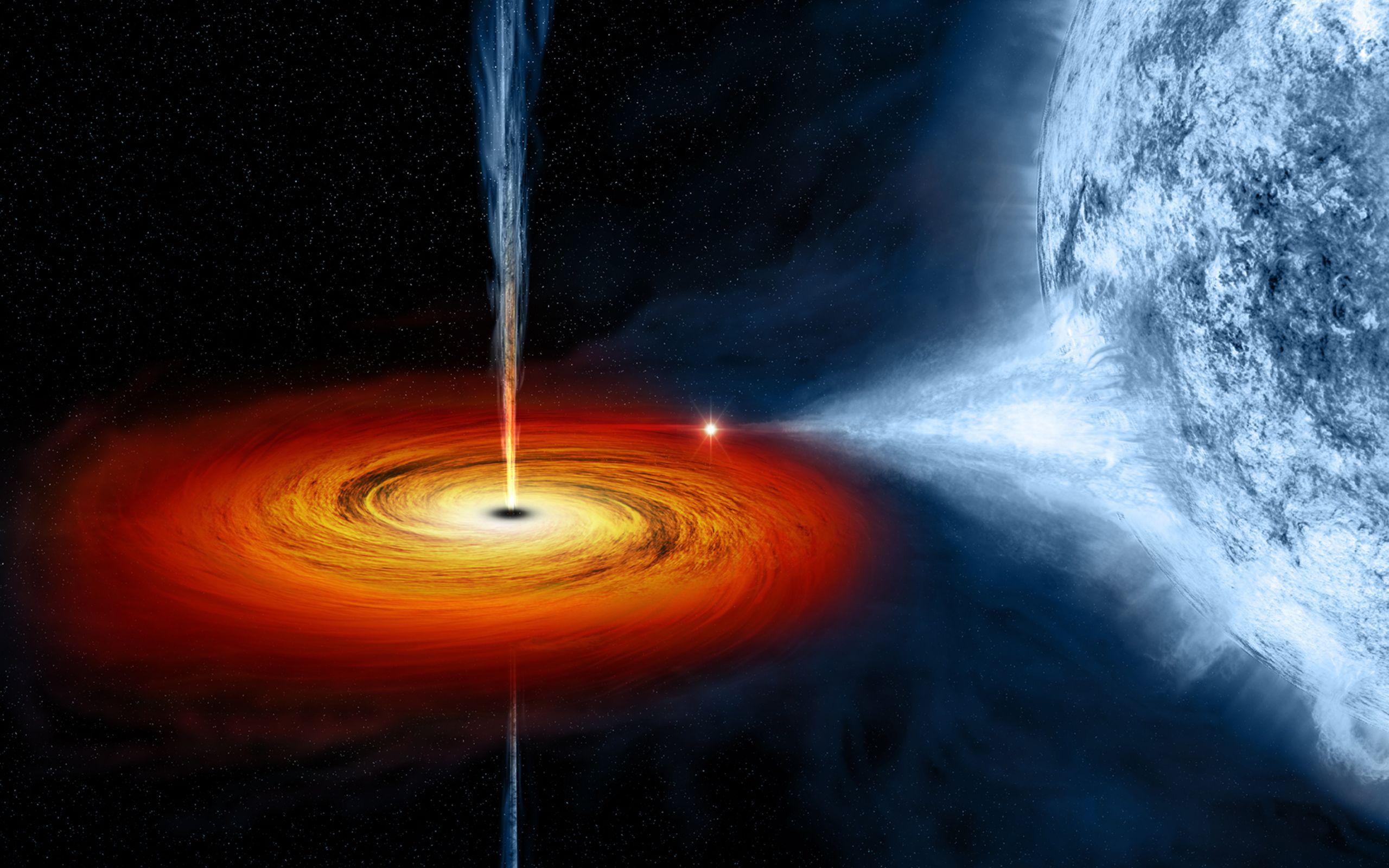
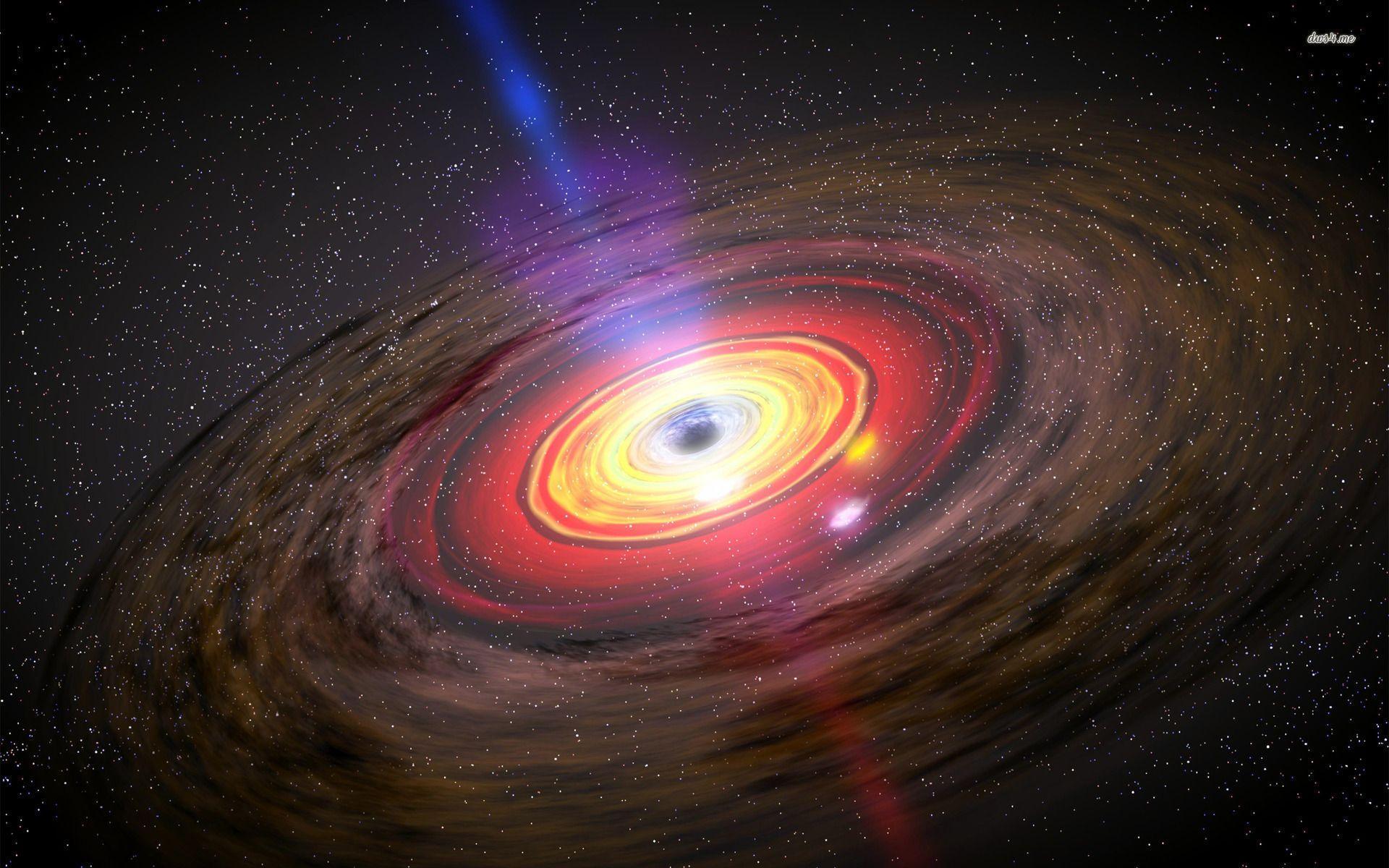
The black hole named Cygnus X-1 formed when a large star caved in. This black hole pulls matter from the blue star beside it. Credits: NASA/CXC/M.Weiss

Caption text

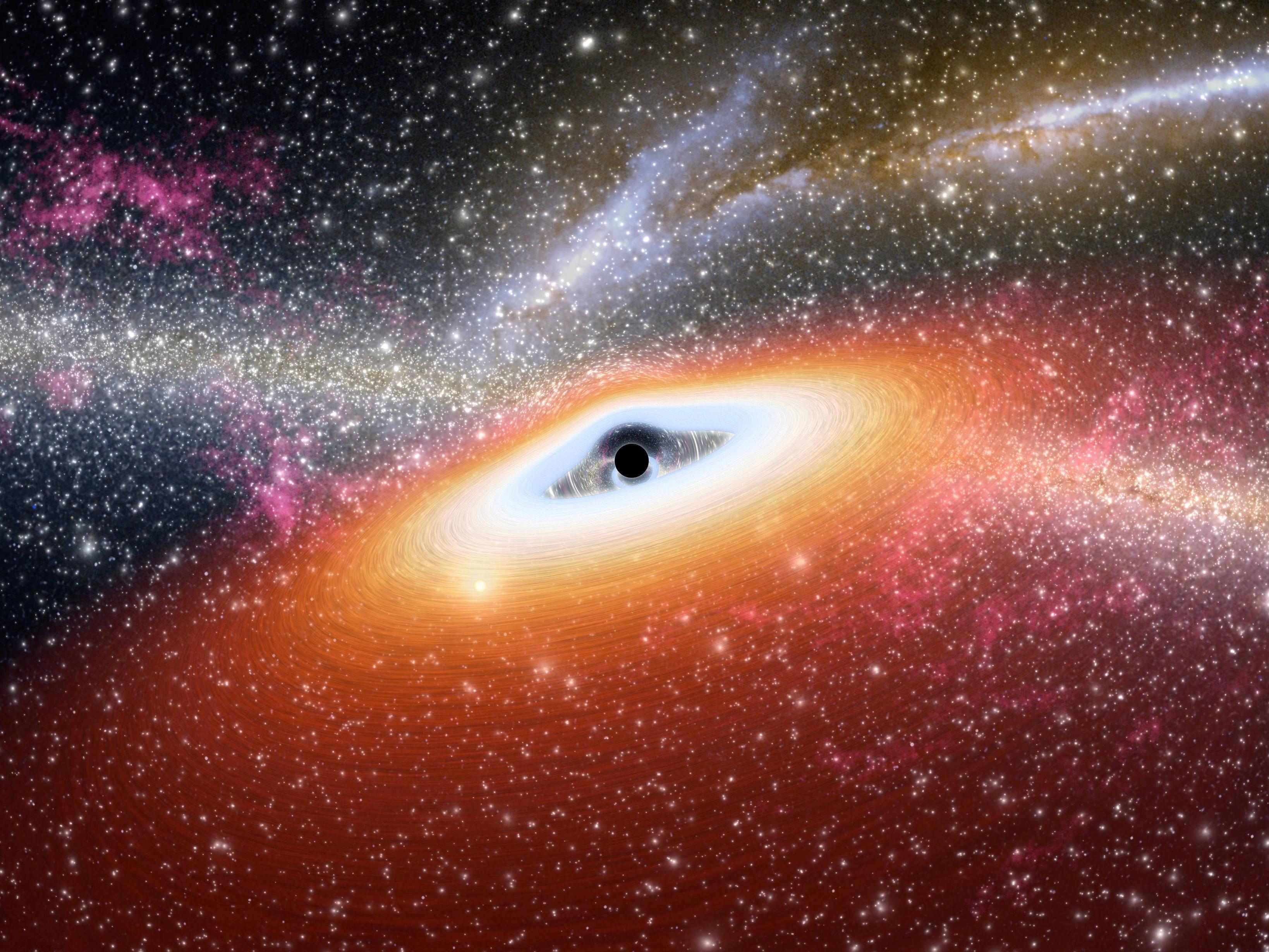
Illustration of a young black hole, such as the two distant dust-free quasars spotted recently by the Spitzer Space Telescope.(Image credit: NASA/JPL-Caltech)

Caption text

NASA Visualization Shows a Black Hole’s Warped World https://www.nasa.gov/feature/goddard/2019/nasa-visualization-shows-a-black-hole-s-warped-world)

Thursday, October 15, 2020

The super massive Sagittarius A*.

What supermassive black holes really are ?

  Supermassive black holes exist at the centre of every spinning galaxy. They are very huge and continuously feed themselves off the surrounding matter. Astronomers are monitoring the colossal object called "Sagittarius A*," the supermassive black hole that exists at the centre of the Milky Way galaxy. The Sagittarius A* is a supermassive black hole at the rotational centre of the Milky Way galaxy, also known as the galactic center. The galactic centre is 26,490  100 light-years away from Earth in the direction of the constellations Sagittarius, Ophiuchus, and Scorpius, where the Milky Way appears brightest. It coincides with the compact radio source Sagittarius A*. The presence of numerous stars, most notably the S2 star, has provided evidence of the presence of the Milky Way's central supermassive black hole, and has led some scientists to conclude that Sagittarius A* is beyond any reasonable doubt the site of that black hole.

So, how big our galaxy is and where the black hole is…?    


     Our galaxy, the Milky Way galaxy, is one of the galaxies in the cluster of many galaxies. It is not very huge and bright if we compare it with the largest galaxy known to us, which is IC 11O1, which has a diameter of 6 million light-years and is the single largest galaxy that has ever been found in the observable universe, as that of the Milky Way is just about 100,000 light-years. By the calculations, Sagittarius A* is situated at the centre of it, which is nearly 26000 light-years away from us, and by the calculations, it is roughly 4.1 million times more massive than the sun.


 How we can see the Sagittarius A* ?

  Astronomers have been unable to observe Sagittarius A* in the optical spectrum because of the effect of 25 magnitudes (i.e., one unit less brightness of an object in a defined passband) of extinction by dust and gas between the source and Earth, and also because the black hole itself cannot be seen because it acts as a one-way path even for light. But it is possible to detect radiation blazing from gas and dust just outside the "event horizon" as they are accelerated, which is about 1/10 the speed of light. The brightness of the black hole at the heart of our galaxy has increased by 75 percent—the brightest it has been since scientists first started studying it more than 20 years ago, as it is continuously feeding the matter surrounding it. It is said that more gas is falling into the black hole, and that leads to higher amounts of accretion, which leads to it being brighter. Sagittarius A* is on the verge of being imaged by the Event Horizon Telescope. When it’s accomplished, the picture of the Milky Way’s supermassive black hole, Sagittarius A*, will be the greatest success for all of us.

Thursday, September 17, 2020

The journey continues towards the black hole.


So, what happens around it…?

         The mysterious objects that lie far away beyond our reach are those mysterious objects that give very little information about them, but the search for all new information goes on every day and every time we get some new information. We know and can tell what happens outside the black hole near it, but we don't have any chance to know what's inside it. As we approach the event horizon, the pull of gravity towards its center, i.e. the singularity, becomes so strong that we must travel faster than the speed of light to escape, which is currently impossible for us. Also, if we try to send a probe inside it, then it will be impossible for it to transmit signals back to us, as the pull of the black hole is so strong that even light can't escape its grasp.


Thermodynamics opposes it.

       So, according to it, whatever goes inside never comes back. This is what deviates from the second law of thermodynamics. Imagine if you threw a bucket full of hot water into a black hole. Then, according to the second law of thermodynamics, entropy is always an increasing function in a closed system, and the universe is a closed system. So, the hot water thrown inside a black hole will lose its entropy eventually as it falls into the black hole.


So, how are they so bright ?


       The black part that we see is actually the event horizon. Then what's the big deal about? A black hole is the singularity that lies at the centre, deep inside, where the whole mass is dense. When we see a picture of a spiral galaxy, we see a super source of light at the centre of it. That is a black hole. But from where the light comes from, as we know, even light can't escape the pull of a black hole. So, the light that we see comes from the magnetic field near a spinning black hole that propels electrons outward along the rotational axis and produces radio waves.

Quasars are quasi-stellar objects that are very highly energetic objects that surround an actively feeding, super massive black hole. That is, the black hole at the centre of each galaxy continuously feeds intermittently, and due to these feedings, highly dense gas moves at a very high speed. It forms an extremely bright and hot disc spiralling around the black hole, and if this black hole is continuously swallowing a large amount of material, this feeding results in gigantic jets of gas that are quasars. These quasars are the fuel for the black hole. But still, black holes continuously radiate their mass away, like a pot filled with water boiling on the stove and the water turning into steam and becoming smaller and smaller. This is known as Hawkins radiation. But this process is very, very slow.


Wednesday, July 15, 2020

Black Hole: Definition & History

What Are Black Holes?  

Black holes are the super-massive, dense regions of space-time where gravitational acceleration is so strong that nothing can pass through them, not even light can escape through them.


History Of Black Holes.

     Black holes were first considered in the 18th century by John Michell and Pierre-Simon Laplace. Then, in 1916, Karl Schwarzschild found the first solution to the theory of general relativity that would describe black holes. He also discovered the concept of Schwarzschild radius, which describes how large a black hole can be based on its mass or density. But the concept that nothing can escape the pull of a black hole, which means that the gravitational black hole is enormous, was first proposed by David Finkelstein in 1958. But, more information about black holes was jotted down when the discovery of neutron stars took place by Jocelyn Bell Burnell in 1967, and from that day till now, every day we get to know more about black holes.

Pathway To Discovery:


    • 1687- Sir Isaac Newton described the gravity in his publication, "Principia"


    • 1783- John Michell suspected that there might be a massive object enough to escape velocity greater than the speed of light.


    •  1796- Simon Pierre LaPlace assumed the existence of black holes." It is, therefore, possible that the largest luminous bodies in the universe may, through this cause, be invisible"- Le Systeme du monde ( The System of the World )


    • 1915- Albert Einstein issued the Theory Of General Relativity, which surmised spacetime curvature.


    • 1916- Karl Schwarzchild used the theory of relativity to explain the black hole.  The explained gravitational radius of black holes, later named as Schwarzchild radius.


    • 1926- Sir Arthur Eddington along with Einstein opposed black hole theory.


    • 1935- Subrahmanyan Chandrashekhar discovered the theory of white dwarfs that led to an understanding of mass limits that decide whether a star will die as a dwarf, neutron star or black hole.


    • 1964- John Wheeler coined the term, "black hole".


    • 1964- Jocelyn Bell Burnell found neutron stars that, at the time, were the densest matter found through inspections.


    • 1970- Sir Stephen Hawking described the modern theory of black holes, which explains the final fate of black holes.


    • 1970- Cygnus X-1, the first good black hole candidate that astronauts found. It releases x-rays and has a partner smaller than Earth although with a mass greater than that of a neutron star.


    • 1994- Hubble Space Telescope gave the best evidence to date pf supermassive black holes that lie low in the centre of some galaxies. The Space Telescope Imaging Spectrograph (STIS) disclosed largely orbiting velocities around the nucleus of these galaxies, proposing a huge mass inside a very small region.


What the laws say?

The laws of general relativity differ from the classical mechanical laws, and according to general relativity theory, a mass sufficiently compressed or compact can deform space-time to form a black hole. A black hole consists of a region around it from which no object can escape. As the pull of gravity is very great in the region, for an object to escape its pull, it needs to travel faster than the speed of light, which was impossible until now. There’s a point at the centre of the black hole which is a single-dimensional point where a huge amount of mass is concentrated in an infinitely small space. That point is known as the singularity of the black hole.


So, how are they really formed…?

         Stars are an enormous mass of hydrogen atoms that collapse from enormous gas clouds under their own gravity. At its core, nuclear fusion crushes hydrogen atoms into helium, releasing an enormous amount of energy. This energy is extremely high. This energy is in the form of radiation, which maintains a balance between gravity and energy. Until there is fusion in the core, the star remains stable, but for stars having a mass far greater than the sun, the heat and pressure in the core allow them to fuse heavier elements until they reach iron. Unlike other elements formed earlier in the core, iron doesn't release any energy, and the balance between energy and gravity is disturbed, and the star implodes, moving at a quarter the speed of light and feeding more mass to the core. At this very movement, the star dies into a supernova or it entirely collapses into a black hole. According to quantum field theory, the event horizon emits Hawking radiation with the same spectrum as a black body of temperature, and it is inversely proportional to its mass.

How we can create them…?

  Any object can collapse into a black hole if it is compressed to its Schwarzschild radius, which is 1.49 times 10–27 m/kg times its mass. This was the most important equation presented by Karl Schwarzschild. That means if we want to convert the sun into a black hole, we have to compress it to about 2.96 km. That is about 0.00000426 times the radius of the sun, and the mass must remain constant. We can also convert a particular object into another by adding mass to it, keeping the density the same. So, if we want to convert the earth into a black hole, then we have to add rock (of comparative density) from all sides equally till it reaches a distance close to the sun. If it reaches it, then the earth will collapse into the black hole.

Furthermore, if we study black holes deeply enough, there is much more to discover.

The topics are broad and deep until the end. far beyond the singularity.